




Uncategorized
When the Camp Ends: What Happens to Resilience After the Adventure?
There is something appealing about the idea that a challenging outdoor experience can make us more resilient.
Put someone in an unfamiliar environment, give them a physical and emotional challenge, add some uncertainty and teamwork and eventually send them home.
But what happens after that?
Does the resilience developed outdoors stay with them when they return to everyday life?
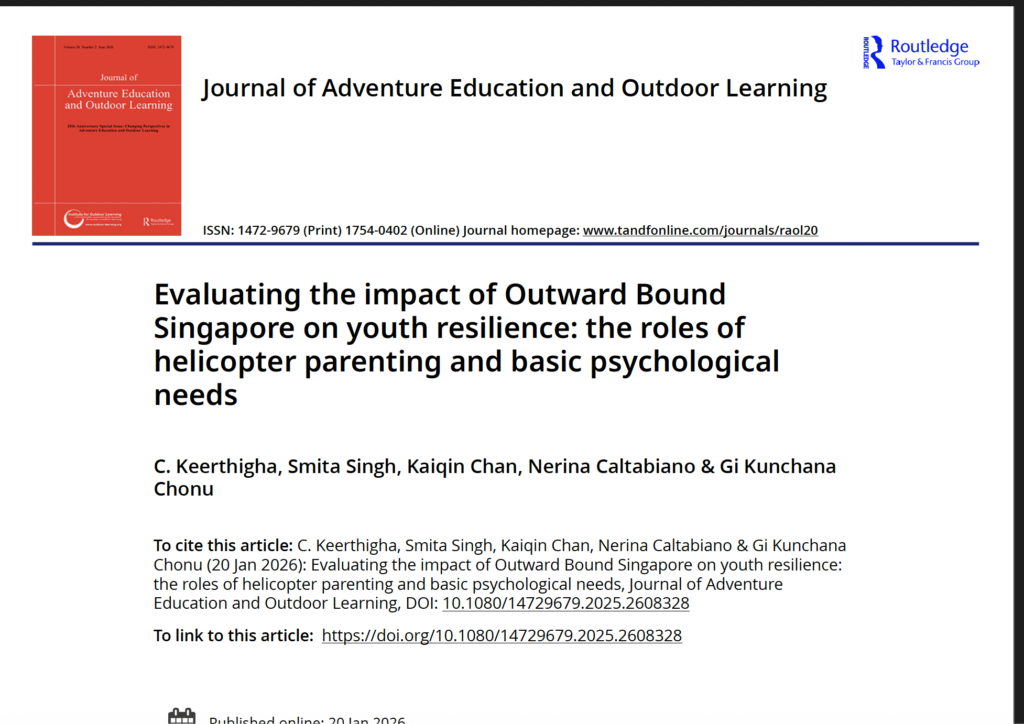
A recently published study by Keerthigha et al. (2026) gives us an interesting opportunity to explore this question in the Singapore context.
What did the study find?
The researchers examined whether a five-day Outward Bound Singapore (OBS) programme could improve resilience among Singaporean youths. They compared students who participated in the programme with a non-intervention group, measuring resilience before the programme, immediately afterwards and again at follow-up. They also explored how resilience related to helicopter parenting and the fulfilment of three basic psychological needs: autonomy, competence and relatedness.
The results were encouraging but also revealing.
Short-term resilience improved significantly immediately after the OBS programme.
However, at follow-up, the difference between the intervention and comparison groups was no longer significant. Long-term resilience also remained unchanged.
In other words, the experience appeared to create a short-term change, but that change did not automatically become a lasting one.
And perhaps this is where the study becomes most interesting for outdoor practitioners.
What happens when the experience ends?
The authors suggest that one reason for the fading effect may be transfer of learning.
What happens outdoors does not automatically transfer to school, home or work. Participants may demonstrate perseverance, problem-solving or leadership during an expedition, but applying those behaviours in everyday contexts requires deliberate reinforcement.
The study also highlights the importance of the environment around the young person. Resilience was associated with the fulfilment of autonomy, competence and relatedness, while the relationship between helicopter parenting and resilience appeared to be more complex than a simple cause-and-effect relationship.
This leaves us with some important questions:
Are we giving young people enough opportunities to practise what they experience outdoors?
Are we designing for transfer, rather than assuming it will happen?
And how can practitioners create environments where young people have genuine opportunities to make decisions, experience competence and build meaningful relationships?
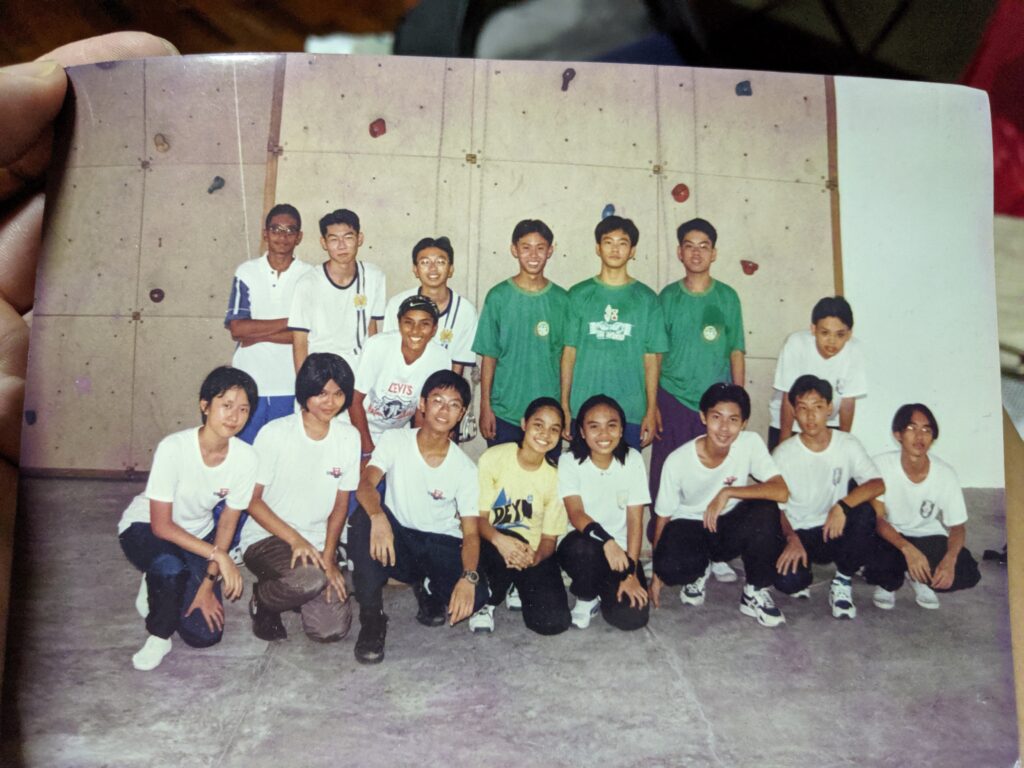
Adrian’s own Outward Bound Singapore journey….back in….(let’s just say pre-2000)
What does this mean for practitioners?
The authors recommend moving beyond isolated interventions towards longer, more integrated approaches, including structured reflection, mentoring, booster experiences and stronger institutional support. They also call for more systematic evaluation of outdoor education programmes.
For practitioners, this might mean thinking beyond the activity itself.
- Design for autonomy: Where can participants make meaningful decisions rather than simply follow instructions?
- Build competence: Are challenges progressive enough for participants to experience genuine mastery?
- Strengthen relatedness: How are we intentionally creating opportunities for connection and contribution?
- Facilitate transfer: Are we helping participants connect their outdoor experiences to their everyday lives?
- Create repetition: Where are the opportunities for participants to practise these behaviours again?
- Evaluate our work: How do we know whether the outcomes we intend to create are actually happening?
A memorable experience is valuable but a memorable experience that participants can understand, practice and apply repeatedly has the potential to become something much more significant.

Where can Blackbox OE contribute?
This is where practitioner development matters.
At Blackbox OE, we believe that creating meaningful outdoor learning experiences requires more than technical competence. It requires practitioners who can intentionally design challenges, facilitate reflection, recognise opportunities for autonomy and support participants in making meaning from their experiences.
Through practitioner training, workshops and consultancy, Blackbox OE can support organisations to strengthen these areas; from facilitation and debriefing to programme design, learning transfer and evaluation.
The study reminds us that resilience is unlikely to be built through one experience alone. It develops through repeated adaptive experiences, supported environments and opportunities to practise what has been learned.
Perhaps, then, our role as outdoor practitioners isn’t simply to create experiences that young people remember.
It is to create experiences that give them something they can continue to use long after the adventure ends.
The adventure may end when participants leave the site but the learning doesn’t have to.
Reference
Keerthigha, C., Singh, S., Chan, K., Caltabiano, N., & Chonu, G. K. (2026). Evaluating the impact of Outward Bound Singapore on youth resilience: the roles of helicopter parenting and basic psychological needs. Journal of Adventure Education and Outdoor Learning.
